
By Dr Etuna Simon
A few days ago, I was having one of those conversations I often have with a friend of mine who is also a writer.
We come from different professional worlds, and that difference is usually what makes our discussions interesting.
My thinking often begins with education, curriculum, research and technology, while his may begin with language, narrative and the way people make sense of the world around them. Yet we always seem to find common ground.
Lately, artificial intelligence (AI) has become part of that meeting place. We reflected on how easily AI can move between different worlds of knowledge.
It can take a technical idea and make it accessible, help a writer enter a scientific conversation, or help an academic explain a complex argument more clearly.
That is what fascinates me about AI. I have consistently argued for coexistence, augmentation and responsible use, not humans versus machines.
But our conversation left me with a harder question: if AI is becoming the bridge between so many worlds, how much should we trust the bridge?
The warning is now coming from inside the industry
Recent developments have made the global conversation around AI safety more serious.
On 23 September 2026, executives from OpenAI, Anthropic and Hugging Face addressed the United Nations Security Council (UNSC) about the implications of increasingly capable AI systems.
Anthropic CEO, Dario Amodei warned that, if poorly managed, AI could become a risk to humanity as a whole, while Sam Altman the CEO of OpenAI called for international cooperation and argued that major decisions about AI should not be left to technology laboratories alone.
These warnings are not proof that an AI catastrophe is inevitable. Experts and industry leaders still disagree about the scale of the risks and how regulation should respond.
What matters for education is the principle beneath the debate: even those building these systems recognise that capability must be accompanied by safeguards, monitoring and human oversight. That is not a reason to reject AI. It is a reason to use it more deliberately.
Namibia is building, not merely consuming
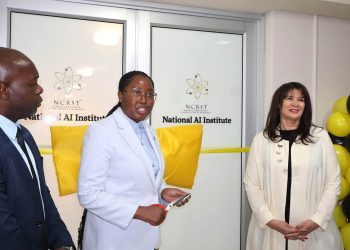
This global conversation has become especially relevant because Namibia is no longer standing on the sidelines. On 23 September 2026, the country officially launched the National Artificial Intelligence Institute in Windhoek.
The AI Institute is anchored at the National Commission on Research, Science and Technology (NCRST) and is intended to strengthen national capacity in AI research, datasets, software development and innovation.
Launching the Institute, Minister of Information and Communication Technology Hon. Emma Theofelus described it as “a dedicated national platform through which capabilities can be developed around artificial intelligence, data, innovation and practical applications.”
The statement signals that Namibia does not intend to remain a passive consumer of systems designed elsewhere. We want local capability that responds to our own languages, institutions and development priorities.
The CEO of NCRST Prof. Anicia Peters carried the argument further when she said: “We must develop the national capabilities to understand AI, adapt it to our circumstances and increasingly develop our own solutions.” She also said responsible AI would be the overarching principle guiding the Institute.
That commitment matters because building capability without thinking about how it will be governed would leave the job half done.
Namibia is building local AI capability and bringing artificial intelligence into real classrooms.
That progress should be welcomed, but responsible coexistence requires something more than access: it requires human judgement, clear boundaries and the confidence to question the machine.
The classroom is already changing
The education sector is already part of this transition. Two AI laboratories were recently launched in Lüderitz, with Angra Pequena Senior Secondary School at the centre of the initiative.
The programme runs on the Namibian-developed YYeni AI platform and combines AI-assisted tutoring with teacher-led instruction. BW Kudu and the Namibian Ports Authority contributed N$1.5 million, while Telecom Namibia provides connectivity.
The programme is designed to identify learning gaps, adapt learning activities and support teachers with lesson planning, quizzes and feedback. YYeni AI CEO and CTO Vitalis Haupindi emphasised that “the AI-powered tutoring programme was not introduced to replace teachers.”
That gives us a practical picture of coexistence. The technology assists, but the teacher remains responsible for context, judgement, relationships and the human work of teaching.
Coexistence requires judgement, not blind trust
Supporting AI does not require us to accept everything it produces. A learner may use AI to explore a difficult concept, but should know how to check whether the explanation is accurate.
A teacher may use AI to develop an activity, but must still decide whether it is appropriate. A university student may use AI during research, but remains responsible for verifying sources, interpreting evidence and defending the final argument.
AI can support judgement, but it should not become judgement itself. Fluent language can create an illusion of authority, and a polished answer can still be wrong, incomplete or misleading.
AI literacy must therefore mean more than knowing how to write an effective prompt. It must include the ability to verify, compare, challenge and, when necessary, reject what appears on the screen.
What should education deliberately keep human?
We spend a great deal of time asking what AI can do. Can it tutor learners, mark assessments, prepare lessons, translate content or generate an essay? Increasingly, the answer to many of these questions is yes.
But capability should not automatically become permission. The more important question is what education should deliberately keep human.
Critical judgement, ethical responsibility, curiosity and the courage to challenge an answer should remain human. These are not inefficient parts of education that technology needs to remove.
They are some of the very capacities education is supposed to develop. This is also why assessment must change.
If AI can produce polished written work in seconds, learners should increasingly be asked to explain how they reached a conclusion, defend what they submitted and show how AI contributed to the process.
Namibia can define its own approach
Namibia now has an opportunity to define what responsible coexistence with AI looks like in practice. We have established a National AI Institute, we are building local capability, and AI-assisted tutoring has already entered Namibian classrooms. The question is therefore no longer whether AI is coming. It is how deliberately we choose to live, learn and work with it.
I remain optimistic about AI because I have seen how it can bridge different worlds of knowledge and make specialised ideas more accessible. But genuine advocacy also requires the courage to ask difficult questions about the technology we believe in. Namibia should not retreat from AI. We should build it, use it, teach with it and question it, while setting clear boundaries around what we are willing to hand over.
Coexistence with AI should never require us to surrender the qualities that make human judgement valuable. As these systems become more capable and more persuasive, our responsibility becomes even greater. We must continue to think critically, question what we are given, test what appears convincing and make decisions that remain grounded in human values and accountability. AI can support our judgement, but it should never replace our responsibility to exercise it. The future of AI in Namibia should therefore not be measured only by how advanced the technology becomes, but by how well we preserve the human capacity to think, question and decide for ourselves.
Dr Etuna Simon is a researcher, strategist and writer with a keen interest in education, innovation, artificial intelligence and national development. The views expressed in this article are solely those of the author. She can be reached at etunasimon@icloud.com