The loudest AI story right now sounds like the Disclosure Day trailer: a coming invasion, that’s already here, humans are finished, and panic is the only rational strategy.
But the practical story is less cinematic. AI is powerful and disruptive, but the claim that it is ready to replace human workers at scale is being inflated by some of the very people who benefit from that inflation.
Scott Galloway’s argument is useful because he separates capability from theatre.
His criticism is not that AI is useless; it is that certain AI leaders sell a dystopian future because fear attracts attention, investment, valuations and enterprise spending.
Convince the world that AI will replace most labour, and every boardroom suddenly feels pressured to buy your tools before the “meteor” hits.
That is not technology strategy. That is Hollywood marketing with a subscription model.
In Namibia and across Africa, we must be careful not to import Silicon Valley’s panic wholesale.
Our business reality is different. Many organisations are not overstaffed with armies of analysts waiting to be automated away.
They are understaffed, under-tooled and buried under manual admin, slow reporting, customer backlogs and compliance paperwork.
In that environment, AI does not remove the worker; it removes the bottleneck.
The employment argument is also more nuanced than the headlines suggest.
The better evidence so far points to augmentation: people using AI to do more, faster and with fewer delays.
Rob Manson’s article highlights research suggesting that AI-exposed roles have largely shown productivity expansion rather than clear net replacement through the recent data window.
In simple business language: when one employee becomes more productive, a growing company does not say, “Great, let us stay the same size forever.” It says, “Now we can take more work.”
That matters. A law firm that drafts faster can serve more clients. A marketing agency that produces faster can run more campaigns. A clinic that automates admin can handle more patients. Productivity creates capacity; capacity creates opportunity.
Of course, some tasks will disappear. Repetitive, low-judgment work is vulnerable. But jobs are not just task lists. They contain trust, context, accountability, relationships and judgment. AI may scan the map, but humans still decide where the vehicle goes.
So before we declare the job apocalypse, let us breathe. AI is not Thanos snapping half the workforce away. It is a power tool: dangerous in careless hands, transformative in skilled hands, and mostly useless when treated as magic.
Part 2: AI Won’t Take Your Job. It Will Take Away Your Excuses.
For years, the professional comfort zone had a familiar playlist: “I do not have time,” “I do not know how,” “I am not technical,” “we need a bigger team,” “we need a consultant,” and the all-time classic, “we will start next quarter.” AI did not destroy that playlist. It pressed skip.
That is the uncomfortable truth. AI will not automatically make someone excellent. But it does make mediocrity harder to hide. It gives the average professional access to writing support, research assistance, planning frameworks, spreadsheet help, coding guidance, design mock-ups, translation, summarisation and training material generation. The barrier is no longer always access to capability. Increasingly, the barrier is willingness.
This is where the conversation must mature. AI is not a replacement for discipline. It is a multiplier of discipline. A lazy person with AI becomes a faster lazy person. A curious person with AI becomes dangerous, in the good sense: more prepared, more articulate, more experimental and more useful.
For Namibia, this should be a wake-up call, not a funeral announcement. We have entrepreneurs who cannot afford full creative departments, teachers drowning in preparation, SMEs struggling with proposals, farms needing better records, churches and NGOs needing communication material, and young professionals trying to compete globally from local soil. AI gives them a practical starting advantage.
But tools do not use themselves. Word did not make everyone a novelist. Excel did not make everyone an accountant. A camera phone did not make everyone Spielberg.
In the same way, ChatGPT, Claude, Gemini or any other model will not turn passive people into high performers by accident. The user still needs taste, judgment, persistence and courage.
The new professional gap will not be between humans and machines. It will be between humans who use machines thoughtfully and humans who are still waiting for permission.
One group will produce drafts, test ideas, learn faster, communicate better and remove friction from their work.
The other group will explain why the Wi-Fi, the economy, the boss, the budget or “the system” made progress impossible.
AI is assistant, tutor, analyst, brainstorming partner and occasionally a confident nonsense machine that must be checked like a toddler holding a permanent marker. But it is also a mirror. It shows us how many of our limitations were real, and how many were rehearsed.
The future will still need people. It will favour people who stop confusing difficulty with impossibility.
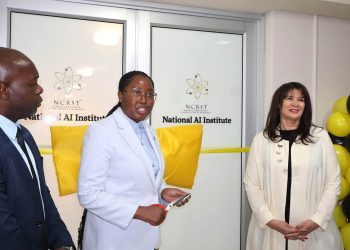
Namibia has launched a National Artificial Intelligence Institute to coordinate AI research, innovation, data development and the deployment of locally developed technology solutions. The institute was launched in...
By Chisom Obiudo A single recording session could give a voiceover artist an unexpected competitor: a digital copy of their own voice. A Windhoek artist might record a...
By Dr Etuna Simon A child sits in a classroom. A question appears on the board. Before the child has finished thinking, an answer can already appear on...
By Chisom Obiudo A confidential board pack can leave the organisation in seconds. All it takes is an employee uploading it to an external AI tool for a...
By Oswald Siku Mughongora Namibia’s termination of the approximately US$2.4 million agreement with American technology company 6th Grain Corporation should not be interpreted as a retreat from artificial...